

Preparing your driveway for a bin delivery in Calgary helps prevent property damage, avoids delivery delays, and allows the driver to position the bin safely on the first attempt. Before a 12 yard or 20 yard bin arrives, it is important to confirm the surface condition, available clearance, and placement area. Suitable placement areas may include driveways, compacted gravel surfaces, or other stable private property capable of supporting the anticipated load. AMC Bins recommends reviewing these factors before delivery so the bin can be placed safely and efficiently.
Understanding the Weight and Footprint of a Roll-Off Bin
A roll-off bin places significant weight onto a relatively small area, particularly once it begins filling with debris. The total load includes both the empty weight of the bin and the material placed inside it. Although the footprint appears compact, much of the load is transferred through the bin’s contact points, creating concentrated pressure on the supporting surface. This is why driveway condition often has a greater effect on damage risk than driveway size alone.
The ideal placement area is flat, stable, and capable of supporting both the delivery truck and the loaded container. Compacted gravel may be suitable in many situations if it provides stable support. Soft ground, lawns, recently paved surfaces, decorative landscaping, or unsupported edges are generally more susceptible to sinking or movement under load.
Differences Between 12 Yard and 20 Yard Bins
Both 12 yard and 20 yard bins are delivered using roll-off trucks, but the larger bin occupies more space and is designed to hold greater volumes of material. As debris accumulates, the overall load can become considerably heavier than a smaller container.
A 12 yard bin is commonly selected for smaller renovation projects, garage cleanouts, household junk removal, and landscaping debris. A 20 yard bin is generally better suited to larger renovations, roofing projects, major cleanouts, or construction waste where additional capacity is required.
The larger footprint and greater loaded weight of a 20 yard bin may require additional placement space and greater attention to surface condition. Regardless of size, both bins require adequate room for the truck to safely position and remove the container.
Surface Protection and Damage Prevention
Many driveways can support a properly placed bin, but suitability depends on factors such as the driveway’s age, structural condition, existing damage, and the anticipated loaded weight of the container. Existing cracks, weakened edges, recently installed pavement, decorative finishes, or areas with poor base support are generally more susceptible to damage than well-maintained surfaces.
Because every property is different, surface condition should be assessed before delivery. If there is uncertainty about whether a driveway can safely support the anticipated load, discussing placement options before delivery can help reduce unnecessary risk. In some cases, another stable private placement area may be more appropriate than the driveway itself.
Asphalt vs Concrete Considerations
Asphalt is generally more susceptible to impressions, scuffing, and deformation during hot weather because it softens as temperatures increase. New asphalt may remain vulnerable for months after installation, depending on weather conditions and curing time.
Concrete typically resists surface deformation better than asphalt, but it is not immune to damage. Existing cracks, decorative finishes, exposed aggregate, weakened edges, or sections with inadequate base support may still be affected by concentrated loads. Stamped, coloured, sealed, or other decorative concrete finishes may also be more susceptible to cosmetic marking or surface damage.
Neither surface guarantees that damage will or will not occur. Existing condition, weather, total weight, and placement location all influence the level of risk.
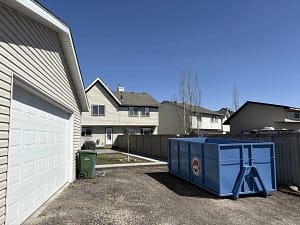
Using Wood Planks or Protective Barriers
Thick wood planks are the most commonly used protective barrier beneath the contact points of a roll-off bin. Their primary purpose is to distribute weight across a larger area while reducing direct contact between the steel bin and the driveway surface.
Protective boards help reduce the likelihood of scratches, scuffs, and pressure marks, but they should not be viewed as a guarantee against damage. If the underlying surface lacks adequate structural support or the finished load becomes exceptionally heavy, damage may still occur despite using protective barriers.
Whether protective boards are supplied as part of delivery or should be provided in advance can vary between rental companies. This should be confirmed before the scheduled delivery date.
Clearance and Access Requirements for Safe Delivery
Safe delivery depends on more than having enough room for the bin itself. The truck must be able to enter the property, position the container, and exit without striking structures, vehicles, trees, or overhead utilities.
Before delivery, verify the following:
- Sufficient overhead clearance for the raised roll-off container during unloading.
- Adequate driveway width for the delivery truck to enter, turn if necessary, and exit safely.
- A relatively level placement area that does not create excessive forward, rearward, or side slope during loading or unloading.
- Vehicles, trailers, basketball nets, low tree branches, fencing, gates, and other obstacles removed from the delivery path.
- Enough open space in front of the placement location for the truck to safely roll the bin into position.
Exact clearance requirements vary depending on the delivery truck and bin size, but overhead obstructions and limited forward space are among the most common reasons deliveries must be repositioned or delayed.
If vehicles or other obstacles cannot be moved before the scheduled delivery, the bin may need to be placed elsewhere on the property if a suitable location exists. Otherwise, delivery may need to be rescheduled.
If access is restricted or uncertain, providing photos of the proposed placement area before delivery can help identify potential issues before the truck arrives.
Winter Conditions and Frozen Ground Risks in Calgary
Frozen ground does not automatically reduce the likelihood of surface damage. While frozen soil may initially feel firmer, repeated freeze-thaw cycles can weaken support beneath the surface as ice melts, allowing heavy loads to settle unexpectedly.
Snow and ice may also conceal driveway edges, landscaping features, utility covers, retaining walls, or other obstacles that affect safe placement. Slippery conditions can further limit how precisely the truck can position the container.
Warm asphalt is generally more susceptible to impressions than frozen asphalt. However, winter introduces different risks related to concealed obstacles, unstable thawing ground, and changing surface conditions rather than eliminating the possibility of damage.
Whenever practical, snow should be cleared from the intended placement area before delivery so the driver can accurately assess the surface condition and position the bin safely.
What Happens If Placement Is Not Properly Prepared?
If the placement area is not adequately prepared, the driver may be unable to safely deliver the bin in the requested location. In some situations, the bin can be repositioned elsewhere on the property if another stable, accessible location is available.
If no suitable private placement area exists, delivery may need to be postponed until access issues or surface conditions have been corrected. Preparing the driveway or other approved placement area before the scheduled delivery helps minimize unnecessary delays and allows AMC Bins to safely place both 12 yard and 20 yard bins for efficient loading and collection.

